For Parents of Future Leaders
Download our Prospectus below

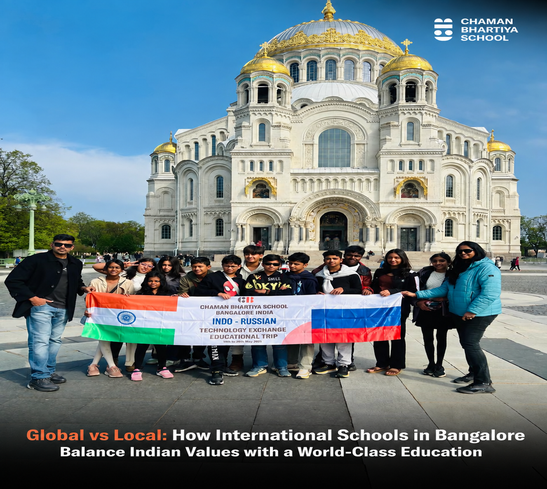
As Bangalore fills up with IB curriculam, foreign didactics, and global exposure programmes, families wonder whether a school can make international standards and Indian everyday life work together smoothly. For many Indian parents, choosing an international school comes with a practical worry: will my child adjust well in an international school while rooted in Indian culture?
Parents often wonder if an IB or Cambridge classroom with its project-based learning, different testing style, and international peer group will feel like a jarring shift from the exam-driven system most of us grew up in. This also raises the question of whether globally set teaching pushes out Kannada, Hindi, or regional festivals from daily school life. It’s a fair concern.
The honest answer is that a good transition depends entirely on how a school combines the two. Schools that get this right treat local language, Indian culture, and community values as part of everyday international classroom life, not just as occasional cultural events.
The nuance of IB is that it doesn't prescribe which local languages or cultural content a school must teach; that's a school-level decision. What the IB requires is a dedicated Language Acquisition subject based on learning another language while also supporting a student's native language, starting from the Middle Years Programme. This framework, combined with a school's own choices, lets even the best international schools in Bangalore weave Indian history, civics, and regional case studies into inquiry-based learning.
There’s also a reason why the Kannada language is included in the curriculum that most parents aren’t aware of. Karnataka's Kannada Language Learning Act of 2015 requires Kannada to be taught as a compulsory subject in every school in the state. However, it does not apply to IB programmes. So when an international school in Bangalore teaches Kannada, it is usually both state law and genuine intent working together.
The Indian languages taught vary by school. The more revealing question is how festivals and national days are celebrated. Is it through active student participation, assemblies, performances, and projects, or a passive notice on a bulletin board? In most schools, Independence Day is a genuine test case, since it usually involves flag-hoisting, patriotic performances, and classroom reflection on what civic responsibility means today. This is the heart of the Indian culture in the international school experience.
The most meaningful shift in Bangalore's IB schools is this framing: global citizenship doesn’t replace national identity; it's built on it. This philosophy of a global school adding local values shows up clearly at Chaman Bhartiya School (CBS), where Director Allan Andersen describes the school's approach as combining India's strong tradition of academic excellence with Scandinavian ideas of holistic development, drawing inspiration from Gandhi, Tagore, and Vivekananda alongside global pedagogy.
How CBS Combines a National Curriculum, an IB Curriculum, and The Indian Community Culture
CBS illustrates this structurally and philosophically. It offers an integrated curriculum up to Grade 5, then splits into national and international paths, with an affiliated ICSE option and an approved IB Middle Years Programme through Grade 10. At Grades 11-12, families can choose between the IB Diploma Programme and Cambridge International A Levels. This means a child can move through global academic programs while staying on one campus, with one community, instead of making an irreversible "international or Indian" choice at admission.
On the cultural side, CBS has celebrated Independence Day with student-led events about democracy and civic duty, and hosted a "Kultural Sangam" exchange program with an Indian NGO and an international youth orchestra, where students introduced visiting Danish students to Karnataka's culture through music and local cuisine, turning cultural pride into something to be shared with the world. It's a clear example of how a ‘global school local values’ approach translates into an actual academic structure, not just in the mission statement.
You can tell if international schools in Bangalore and Indian values blend in a curriculum by looking at one thing: the best schools don't ask you to trade one for the other. They build language, festivals, and community culture into the everyday architecture of an internationally recognised curriculum so a child can move between an ICSE classroom, an IB project, and a festive assembly on the same campus without friction. That quiet consistency is what sets the strongest International IB Schools in Bangalore apart from the rest.
Do international schools in Bangalore teach Indian languages?
Most do. Kannada is a compulsory first or second language across all school boards. However, it is not a requirement for IB. At CBS, the language is included for the Middle Years Programme(Grade 6-10).
Will my child lose their Indian identity if they attend an international school?
Not at a school that treats Indian culture as part of daily academic and campus life. When looking at international schools in Bangalore, ask how a school integrates language, national days, and local context into its curriculum before assuming.
Do international schools in Bangalore celebrate Indian festivals and customs?
Parents asking whether international schools in Bangalore help children retain Indian culture and values usually get their clearest answer by looking at this. Many do, with varying levels of student involvement. At CBS, we run student-led Independence Day commemorations and cross-cultural events centred on Indian heritage.
Is the IB curriculum designed only for children who want to live abroad?
No. It builds critical thinking and inquiry skills valuable for any career path in India. Its language philosophy also explicitly supports maintaining a student's native language rather than replacing it. This balance is what an IB school with Indian identity looks like, global skills layered onto local grounding.
How does CBS maintain Indian cultural values within its international curriculum?
CBS runs ICSE alongside IB and Cambridge pathways rather than replacing one with the other, and has leadership that focuses on blending Indian academic tradition with global pedagogy with a ‘global school, local values’ approach.


Download our Prospectus below